Total nonfarm payroll employment increased by 263,000 in November.
The unemployment rate remained the same at 3.7 percent.
Notable job gains occurred in leisure and hospitality, health care, and government. Employment declined in retail trade and in transportation and warehousing.
Both the labor force participation rate, at 62.1 percent, and the employment-population ratio, at 59.9 percent, were little changed in November.
Long-term unemployed (those jobless for 27 + weeks) was little changed at 1.2 million in November. The long-term unemployed accounted for 20.6 percent of unemployed persons.
Looking Forward:
Job growth was much better than expected in November despite the Federal Reserve’s aggressive efforts to slow the labor market and tackle inflation. Economists surveyed by Dow Jones had been looking for an increase of 200,000 on the payrolls number and 3.7% for the jobless rate.
The numbers likely will do little to slow a Fed that has been raising interest rates steadily this year to bring down inflation still running near its highest level in more than 40 years.
In another blow to the Fed’s anti-inflation efforts, average hourly earnings jumped 0.6% for the month, double the Dow Jones estimate. Wages were up 5.1% on a year-over-year basis, also well above the 4.6% expectation.
Leisure and hospitality led the job gains, adding 88,000 positions. Other sector gainers included health care (45,000), government (42,000) and other services, a category that includes personal and laundry services and which showed a total gain of 24,000. Construction added 20,000 positions, while information was up 19,000 and manufacturing saw a gain of 14,000. On the downside, retail establishments reported a loss of 30,000 positions heading into what is expected to be a busy holiday shopping season. Transportation and warehousing also saw a decline, down 15,000.
When the pandemic first hit, companies had to scramble to find a work-from-home solution within 24 hours. It’s been a few years since that hectic time, and while during the early days, we prayed for everything to “return to normal,” we have accepted that having a work-from-home business model is the new normal.
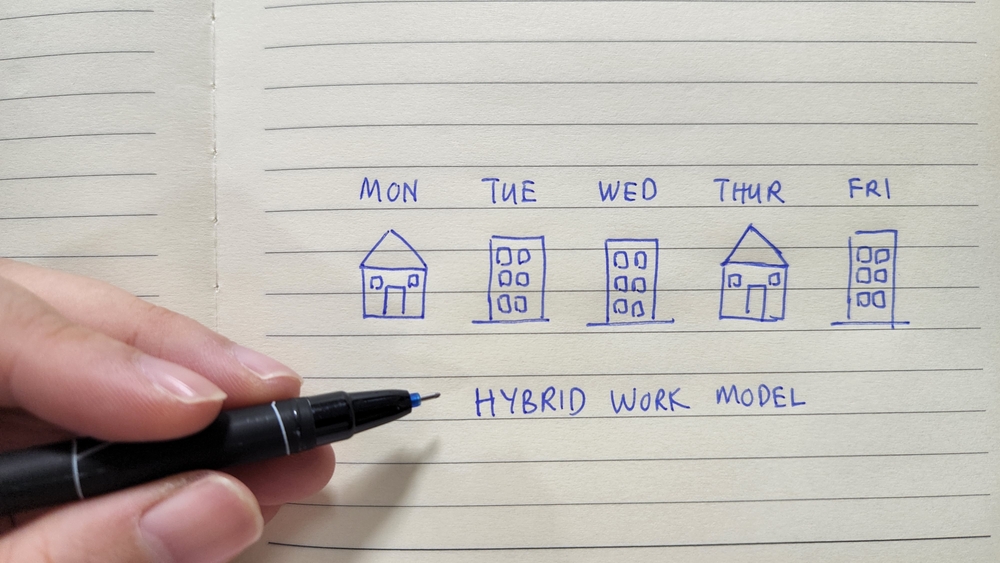
But not all companies can go completely remote; some can only make a couple of days a week work.
The magic is finding the sweet spot for your company and the perfect management style to keep things running smoothly, no matter the environment.
As long as you look at the three most important things as you make this transition, you are bound to be a success. You can’t make a significant business change like this without considering the company’s goals, the managers, and the other employees. All of these things will be affected by any decision, which will, in turn, determine your business’s continued success.
So, how do you manage your whole business from the office and home? The answer is simple: having a plan before transitions start happening.
Management
An essential part of creating a thriving hybrid business environment is ensuring your management works in both the office and remotely. Your company can test this over some time before enacting a company-wide hybrid policy.
That is one of the benefits of going hybrid now versus a few years ago. You can take the time to establish what works best for your company structure and who struggles the most from remote work. Not everyone will take to work from home as easily as it is to breathe. If we learned one thing from early 2020, some people are fantastic managers, teachers, and leaders when their audience/team is right in front of them. However, put a computer screen between them, and they struggle to establish a rapport and authority because they can’t visualize what they need to do.
Taking time to establish a remote option in your workplace slowly allows you to sort out which team leads might need extra support when transitioning to a new way of managing. Giving your employees time to get used to the change in structure will ensure you become a successful remote company when you need to be.
Taking time also allows you to work out any technical issues when setting up home offices. This is a crucial part of management because it’s part of each role working at 100% every day of the week – no matter the situation. Having rules and guidelines in place for when a connection issue occurs will help your company save on downtime.
We will get into this a bit more in a minute, but another crucial part of management is meetings, scheduling, and employee support. All of these must be established before making your remote workplace option available companywide.
As a business owner, you dictate how much your manager needs to be in contact with their team throughout the day. By establishing this scheduled structure from the start, you are giving your managers the tools for success even before they have the opportunity to feel overwhelmed.
These meetings and check-ins can be altered based on workload and capabilities, but they still need to happen at a specific frequency – daily, once a week, every other week, or once a month; you need to make it company policy that they occur. This way, your employees aren’t just out there doing whatever they want without making themselves available for the responsibilities of their position.
Scheduling
Most importantly, you must determine how your hybrid schedule will be set up—having a plan will make it easier to manage your employees’ expectations. Employees are less likely to abuse the system if they know how many and which days they are allowed outside of the office.
When planning the schedule, you need to decide your company’s needs, each role’s needs, and how often you can afford your employees to be out of the office. No two companies will have the same hybrid plan because each situation is unique. The most important thing to remember is to find what works best for you.
It would be best if you also considered allowing your employees some schedule flexibility. Whether you decide they can have access to this flexibility from the start or it is a perk for them once they’ve established that they can handle working from either environment. You have to assess what works best for your company overall and the various roles within the company.
Don’t let scheduling bog you down. When you first start, decide on a schedule and stick to it. Choosing to have a whatever-goes attitude from the start can create tricky problems with staffing that you don’t need. If you realize after a few months of hybrid that your company can afford more at-home days or need less, you can adjust to fit the needs.
Maintaining Culture
One of the first things to suffer when deciding to go hybrid is the overall business model, which includes your culture. More often than not, when your company was created, it was with the mindset that everyone would be in the office every day and interacting with one another face to face quite regularly. Naturally, when you take your business hybrid, there are going to be some adjustments needed.
Company culture can seem effortless to establish when your workforce is in-person. When you adjust your practices, that culture could take a significant hit if you aren’t careful. While the culture may remain as it has always been for your seasoned employees, whenever you bring on new hires after this change, you need to have a plan to convey that culture to them despite not being in person.
It’s easy for new hires not to understand the values, beliefs, and vibe of the company they work for when their interactions with coworkers and managers are limited. Knowing this will help you set up a successful transition and path forward.
You don’t need to change your culture’s basic structure; you need to adjust it to fit a more tech-centric environment. If you used to have monthly team-building exercises, you should continue that trend but find new ways for them to be exciting and fun even if members join in virtually.
Make sure these team-strengthening activities, which are a big part of your culture, remain well-attended and have feedback from everyone involved. This way, your teams still feel like teams despite not meeting in person.
Part of adjusting your company and your culture is changing your communication style. With not as much face time, some employees may need increased communication throughout their days to feel less on an island. Ensure your company policies and best practices include a structure for this change.
Communication ensures everyone is a success no matter where they work. It enhances your culture and provides employees with the support they need to be their best.
Hiring Practices
Ensuring your culture withstands the move to remote work is extremely important when considering your hiring practices. During the hiring process, you will need to account for a remote employee’s inability to know the office’s culture from experience. This means you must adjust your culture so that new hires understand the company from day one, even if they never step foot in the office or meet their coworkers.
You can make some significant changes to your hiring process because of remote work. One of the major ones is you can adjust compensation to reflect the changes made to your company structure. Depending on how remote you can feasibly make your company, you may be able to extend your pool of candidates from your area to include the whole United States.
In a hybrid world, it might be beneficial for your onboarding process to include time spent in the office. This can ensure your new hires are going to be good fits for the remote aspect of your company. It also gives you a chance to introduce new employees to the executives of the company as well as their direct managers. Making this meet and greet part of their orientation is crucial if you have to do a virtual onboarding.
You want to ensure your practices help the 90% of employees who will thrive in whatever environment your company gives them and the 10% who may need extra help for whatever reason.
How We Can Help
J & J Staffing has been on a hybrid business model since the start of the pandemic. Our company continues to thrive and adjust to each new challenge. As the area’s premier staffing resource, we know how companies have worked around this new normal. If you need help hiring any new employees for hybrid or just some more tips on what best practices you can use, give us a call.
Staffing Services In Greater Philadelphia
J & J Staffing Resources is a professional staffing agency that connects local businesses to job seekers throughout the Greater Philadelphia area, including Pennsylvania, New Jersey, and Delaware.
We bring over 45 years of expertise in office, industrial, technical, and professional staffing placements as well as payroll management, and offer a wide range of services for both employers and job seekers.
Need help? J & J Staffing has offices in Newark, Bridgeport, Woodbury, Cherry Hill, Ewing, Princeton, Langhorne, and Horsham. Visit your local J & J staffing center or get started below.
Total nonfarm payroll employment increased by 261,000 in October.
The unemployment rate rose to 3.7 percent.
Notable job gains occurred in health care, professional and technical services, and manufacturing.
The labor force participation rate, at 62.2 percent, and the employment-population ratio, at 60.0 percent, were about unchanged in October.
The number of long-term unemployed (those jobless for 27 weeks or more) was little changed at 1.2 million in October.
Looking Forward:
Job growth was stronger than expected in October despite Federal Reserve interest rate increases aimed at slowing what is still a relatively strong labor market. Nonfarm payrolls grew by 261,000 for the month while the unemployment rate moved higher to 3.7%.
Healthcare led job gains, adding 53,000 positions, while professional and technical services contributed 43,000, and manufacturing grew by 32,000. Leisure and hospitality also posted solid growth, up 35,000 jobs, though the pace of increases has slowed considerably from the gains posted in 2021. The group, which includes hotel, restaurant and bar jobs along with related sectors, is averaging gains of 78,000 a month this year, compared with 196,000 last year.
The new figures come as the Fed is on a campaign to bring down inflation running at an annual rate of 8.2%, according to one government gauge. Earlier this week, the central bank approved its fourth consecutive 0.75 percentage point interest rate increase, taking benchmark borrowing rates to a range of 3.75%-4%.
Risks to the economy are growing as the Fed continues to battle high inflation, said economists surveyed by The Wall Street Journal last month. They put the probability of a recession in the next year at 63%, up from 49% in July’s survey.
Total nonfarm payroll employment increased by 263,000 in September.
The unemployment rate edged down to 3.5 percent.
Notable job gains occurred in leisure and hospitality and in health care.
The labor force participation rate was little changed at 62.3 percent in September, and the employment-population ratio was unchanged at 60.1 percent.
The number of long-term unemployed (those jobless for 27 weeks or more) was little changed at 1.1 million in September. The long-term unemployed accounted for 18.5 percent of all unemployed persons.
Looking Forward:
The number of job openings fell 10% in September to a seasonally adjusted 10.1 million from 11.2 million the month before, the Labor Department reported. The 1.1 million drop in openings is the largest decline since the early months of the Covid-19 pandemic in 2020. That left job openings at their lowest level in a year.
Many firms slowing hiring or laying off workers are in industries that are highly sensitive to interest-rate increases, such as technology and real estate. Some companies that saw a rise in demand earlier in the pandemic are also cutting back as consumer preferences shifted from goods to services.
Fed Governor Christopher Waller: “Expectations are for job gains of around 260,000, which would be lower than recent months but very healthy relative to past experience. A jobs number in this range along with the job openings rate reported on Tuesday would show that the labor market is slowing a bit but is still quite tight. As a result, I don’t expect tomorrow’s jobs report to alter my view that we should be focused 100 percent on reducing inflation.”
Jobless claims also increased more than expected last week, with the number of Americans filing first- time unemployment benefits rising to 219,000, a five-week high.
Total nonfarm payroll employment rose by 315,000 in August.
The unemployment rate increased to 3.7 percent.
Notable job gains occurred in professional and business services, health care, and retail trade.
The number of unemployed persons increased 344,000 to 6 million.
The number of long-term unemployed (those jobless for 27 weeks or more) was little changed at 1.1 million in August. The long-term unemployed accounted for 18.8 percent of all unemployed persons.
Looking Forward:
Nonfarm payrolls rose solidly in August amid an otherwise slowing economy, while the unemployment rate ticked higher as more workers rejoined the labor force, the Bureau of Labor Statistics reported Friday.
Professional and business services led payroll gains with 68,000, followed by health care with 48,000 and retail with 44,000. Leisure and hospitality, which had been a leading sector in the pandemic-era jobs recovery, rose by just 31,000 for the month after averaging 90,000 in the previous seven months of 2022. The unemployment rate for the sector jumped to 6.1%, its highest since February.
The jobs numbers pose a quandary for a Federal Reserve trying to get inflation under control. Inflation is running near its fastest pace in more than 40 years as a combination of a supply-demand imbalance, massive stimulus from the Fed and Congress and the war in Ukraine has sent the cost of living soaring.
Some signs point to an economy that is rapidly cooling under the weight of high inflation. The Fed is raising interest rates to slow the economy and curb price increases. Some major employers, including Ford Motor Co., Snap Inc., T-Mobile US Inc. and Wayfair Inc., have announced job cuts in the past few weeks.
In today’s hiring landscape, it isn’t enough to just stand out with your company culture and benefits. You also have to ensure that the hiring process for your positions is quick. Otherwise, you will be left with an open position that negatively affects your productivity.
This is why a quick hiring process is a way to beat your competition. People want to work but don’t want to spend too much time getting the desired job opportunity. If the process takes too long with one job, candidates will move on to other opportunities. You need to fill a position and they need a job so make the process quick to ensure you get them in the door.
A Shorter Process Means More Candidates
The shorter the process the more qualified and motivated candidates you are going to find. The candidate drives today’s job market – this means that their needs and desires strongly influence what jobs they pursue. If you have a short but meaningful hiring process, your candidates will take notice and put you toward the top of their desired job list.
The less time it takes to walk a candidate through your process, the more excited they will be about the job. In short, no one wants to do work for free – which is exactly what you are asking of your candidates the more complex your process is. Also, most job seekers are looking for a solution that will change their status quo as soon as possible, not something that will make a change a few weeks down the road.
You can’t think that a candidate will wait around forever. They are looking at multiple offers at the same time. The fastest one to respond to them with the best offer is going to be the one they choose – make sure you are that choice. This doesn’t mean you need to completely change your whole process, just pick up the pace a bit.
Ways You Can Speed Up Your Current Process
Getting candidates through the hiring process faster doesn’t require you to change much about your current process. The little things can work wonders to speed up your current wait time and get you the candidates you need before they choose someone else.
Be quick to respond – First and foremost, when a candidate reaches out to you regarding their application or with any questions they have, be swift in your reply. Don’t let an email or phone call go unanswered for more than 24 hours. Your time is valuable, and so is theirs.
Attitude matters – skills can be taught – Going into this process with the right attitude can minimize any extra time that may be added on because a candidate gets the wrong impression from you. Likewise, knowing what kind of attitude you need from someone you wish to employ goes a long way toward the decision-making process. Don’t be afraid to turn down a skilled candidate with a bad attitude. Skills can be honed and developed, but an attitude cannot.
Hold effective interviews – Ultimately, you can make or break your chances with a candidate if your interview process isn’t streamlined and efficient. Come into the meeting prepared to speak about the job, its benefits, and what you need from a candidate. Also, leave time for the candidate to ask any questions they may have for you.
Create engaging job ads that list all requirements – An important step that you can take towards speeding up your process and ensuring you won’t be wasting anyone’s time is through your initial job ad. If you make the job sound engaging and worth checking out, more candidates will engage. Knowing the complete job requirements upfront will shorten the process time because it will limit engagements to people who know they are qualified.
Staffing Agencies Can Help
When you are understaffed, it’s hard to get through a typical work day and the number of applications coming in to fill your vacant positions. This added pressure ends up either making your work suffer or the applications sit on hold for a longer period than necessary. It doesn’t have to be this difficult, though, and there are solutions to help you get through the process of hiring new employees at a quicker speed.
The best solution is to hire someone whose job it is to look through applications. This can be accomplished through an in-house position. Or by hiring a third-party staffing agency to divert all your applications.
A staffing agency, such as J&J Staffing, is a great resource to turn to especially if you aren’t sure what you should do to speed up your hiring process. They are well equipped with knowledge of the latest hiring trends and can help you sort out the best solution.
No matter what, a staffing agency will do exactly what you need. It is their job to assist you and make your staffing needs less stressful. Trusting a staffing agency ensures that you are working to keep the best candidates interested in you by creating the smoothest process that takes the least amount of time.
Hiring Should Be Easy! So Don’t Sweat It!
Finding the right employee shouldn’t feel like an insurmountable task. If you don’t have the time and energy to devote to in-house hiring, ask a staffing agency to help you out. The process should be fun and exciting, not tedious and stressful.
You don’t want to spend a long time on the hiring process and neither do your candidates. Do everyone a favor and streamline everything so that, in the end, everyone is happy with the time spent.
Even if you can handle in-house staffing needs, consulting a staffing company could help you decide what ways you can ensure your hiring process is the best out there. Remember, you want to beat your competition to the finish line with a candidate.
Let J&J Staffing help you out with all your hiring needs. Contact us today.
Staffing Services In Greater Philadelphia
J & J Staffing Resources is a professional staffing agency that connects local businesses to job seekers throughout the Greater Philadelphia area, including Pennsylvania, New Jersey, and Delaware.
We bring over 45 years of expertise in office, industrial, technical, and professional staffing placements as well as payroll management, and offer a wide range of services for both employers and job seekers.
Need help? J & J Staffing has offices in Newark, Bridgeport, Woodbury, Cherry Hill, Ewing, Princeton, Langhorne, and Horsham. Visit your local J & J staffing center or get started below.
Total nonfarm payroll employment rose by 528,000 in June.
The unemployment rate edged down to 3.5 percent.
Job growth was widespread, led by gains in leisure and hospitality, professional and business services, and health care.
The number of unemployed persons edged down to 5.7 million.
Both total nonfarm employment and the unemployment rate have returned to their February 2020 pre-pandemic levels, prior to the coronavirus (COVID-19) pandemic.
The number of long-term unemployed (those jobless for 27 weeks or more) decreased by 269,000 in July to 1.1 million.
Looking Forward:
U.S. employers added 528,000 jobs in July as the labor market now has recovered all 22 million jobs lost in the pandemic and continued to defy soaring inflation, rising interest rates and a slowing economy.
Last week, however, initial jobless claims, a gauge of layoffs, rose to the highest level since November based on a four-week moving average. Tech giants such as Oracle, Amazon, Netflix and Robinhood have all announced significant job cuts recently.
Regardless of whether a recession is eventually declared, the latest economic figures show that output is weakening much faster than the job market. The disconnect between the growing job market and otherwise faltering economy boils down to one key point: Despite slowing consumer demand, the supply of workers to make goods and provide services has been considerably below companies’ needs.
Americans still aren’t staying in their jobs, even as fears of a recession settle over the economy. In June, 4.2 million people quit their jobs, according to new data out from the Bureau of Labor Statistics. At the same time, hiring wasn’t slowing down: 6.4 million Americans were hired in June, and the layoff rate stayed low at 0.9%. That means that, even as some do see layoffs and hiring slowdowns, workers for the most part aren’t worried about walking away from their jobs.
Total nonfarm payroll employment rose by 372,000 in June.
Unemployment rate remained unchanged at 3.6 percent.
Notable job gains occurred in professional and business services, leisure and hospitality, and health care.
The number of unemployed remained essentially unchanged at 5.9 million.
The number of long-term unemployed (those jobless for 27 weeks or more) was essentially unchanged at 1.3 million.
The number of job leavers – that is, unemployed persons who quit or voluntarily left their previous job and began looking for new employment – increased by 68,000 to 832,000 in May.
Looking Forward:
The unemployment rate in June remained at 3.6% for a fourth straight month, the Labor Department said Friday, matching a near 50-year low that was reached before the pandemic struck in 2020.
Many employers are still struggling to fill jobs, especially in the economy’s service sector, with Americans now traveling, eating out and attending public events with much greater
frequency. The Fed may see the June job gains as evidence that the rapid pace of hiring is feeding inflation as companies raise pay and then raise prices to cover higher labor costs.
Fed Chair Jerome Powell has held out hope that the economy will continue to expand even as the central bank raises borrowing costs at its fastest pace since the late 1980s. But Powell has also acknowledged that overseas factors, such as Russia’s invasion of Ukraine, which has elevated gas and food prices, will make it difficult to avoid a recession.
Inflation hit a 40-year high of 8.6% in May amid lingering supply-chain troubles and Russia’s war in Ukraine. Sharply climbing prices are squeezing companies’ profit margins, leading many to scale back hiring plans, says economist Lydia Boussour of Oxford Economics. Consumers are also cutting back as costs swell. Manufacturing and service sector activity is expanding more slowly. And initial jobless claims, a gauge of layoffs, have trended higher in recent months, though they’re still historically low.
Total nonfarm payroll employment rose by 390,000 in May.
Unemployment rate remained unchanged at 3.6 percent.
Notable job gains occurred in leisure and hospitality, in professional and business services, and in transportation and warehousing. Employment in retail trade declined.
The number of unemployed remained essentially unchanged at 6 million.
The number of long-term unemployed (those jobless for 27 weeks or more) little changed at 1.4 million.
The number of job leavers – that is, unemployed persons who quit or voluntarily left their previous job and began looking for new employment – declined by 29,000 to 763,000 in May.
Looking Forward:
The U.S. economy continued to see healthy job growth in May, indicating the labor market is still strong despite growing fears of a recession amid sky-high inflation and an increasingly aggressive Federal Reserve.
Job gains were broad-based, with the biggest increases in the pandemic-battered leisure and hospitality industry (84,000), professional and business services (75,000) and transportation and warehousing (47,000). Nearly every industry gained positions last month, with one notable exception: Retail, which shed nearly 61,000 jobs.
Businesses are eager to onboard new employees and are raising wages in order to attract workers as they confront a labor shortage. There were roughly 11.4 million open jobs at the end of April – near a record high – while the number of Americans quitting their job is also well-above pre-pandemic levels.
Fed Chairman Jerome Powell has acknowledged there could be some “pain associated” with reducing inflation and curbing demand but has pushed back against the notion of an impending recession, identifying the labor market and strong consumer spending as bright spots in the economy. Still, he has warned that a soft landing is not assured.