

Quick Facts:
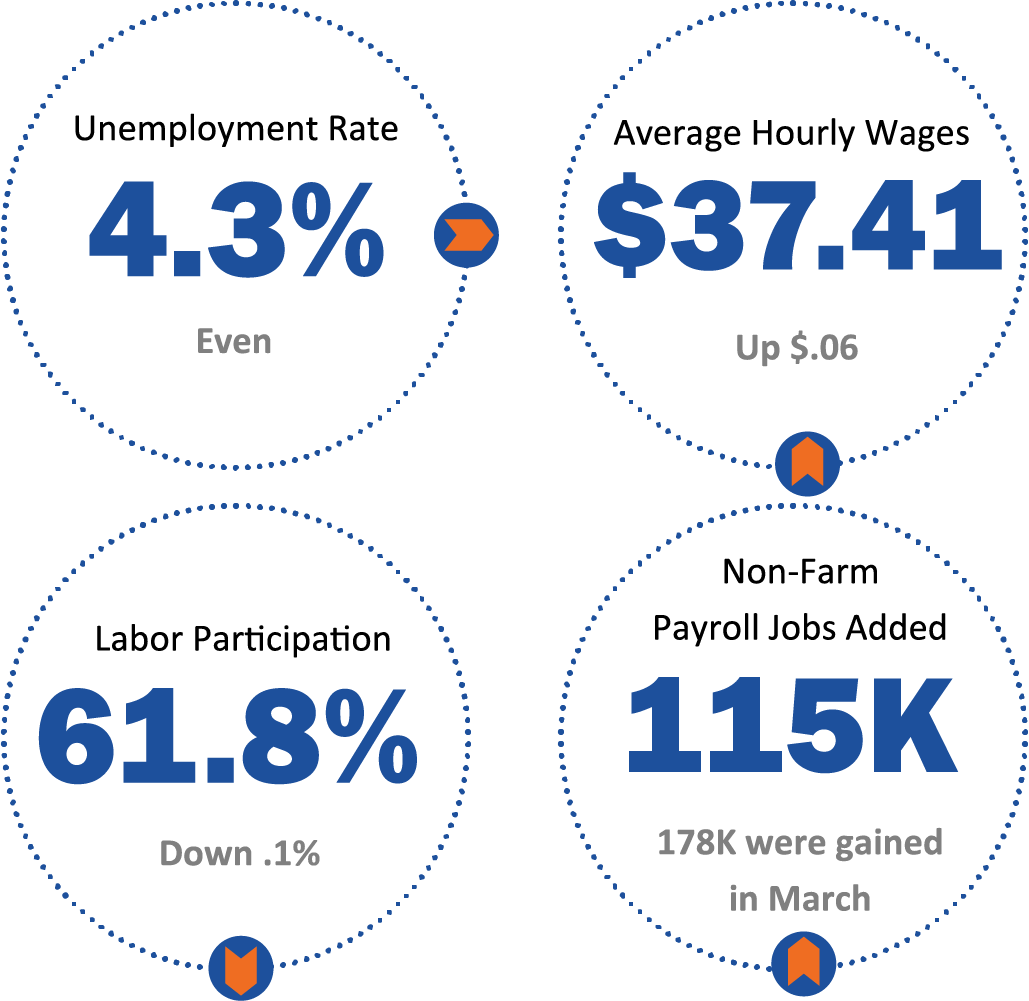
- Total nonfarm payroll employment edged up by 115,000 in April, and the unemployment rate was unchanged at 4.3 percent
- Job gains occurred in health care, transportation and warehousing, and retail trade. Federal government employment continued to decline.
- The number of long-term unemployed (those jobless for 27 weeks or more) was essentially unchanged at 1.8 million and accounted for 25.3 percent of all unemployed people.
- The number of people employed part time for economic reasons increased by 445,000 to 4.9 million.
Looking Forward:
- “More solid jobs data leaves the Fed where it’s been for a while
– watching and waiting, focused on the inflation side of its
mandate. Rate cuts still aren’t on the near-term horizon, but
the absence of inflationary threats in today’s report should quiet
some of the chatter about a potential hike,” said Ellen Zentner, chief
economic strategist for Morgan Stanley Wealth Management.
- “The April jobs report smashing expectations thanks to robust private-sector growth is yet
another sign that the American economy remains on a solid trajectory under President
Trump,” White House Senior Deputy Press Secretary Kush Desai said on X shortly after
the report was released. Stocks climbed on the news, improving on recent gains. The
job tally reported by the Bureau of Labor Statistics was a “clear upside surprise,” Eric
Merlis, a managing director and co-head of global markets at Citizens Bank, said in a
note shortly after the report’s release.
- Fuel prices surged over the last two months after the war in Iran snarled tanker traffic through the Strait of Hormuz, a key waterway for 20 percent of the world’s supply of oil and gas. And the economic effects of the war have further damaged Trump’s standing on the economy, which poses serious challenges to Republican leaders in their bid to maintain control of Congress in the midterms.
- Transportation and warehousing added 30,000, retail rose by 22,000, and social assistance saw a gain of 17,000. On the downside, information services lost 13,000, part of a continuing trend that has seen the category down 342,000 jobs since November 2022, coinciding with the rise of artificial intelligence. That has equated to a loss of 11% of jobs.
Source: U.S. Bureau of Labor Statistics – The Employment Situation – April 2026
