
Quick Facts:
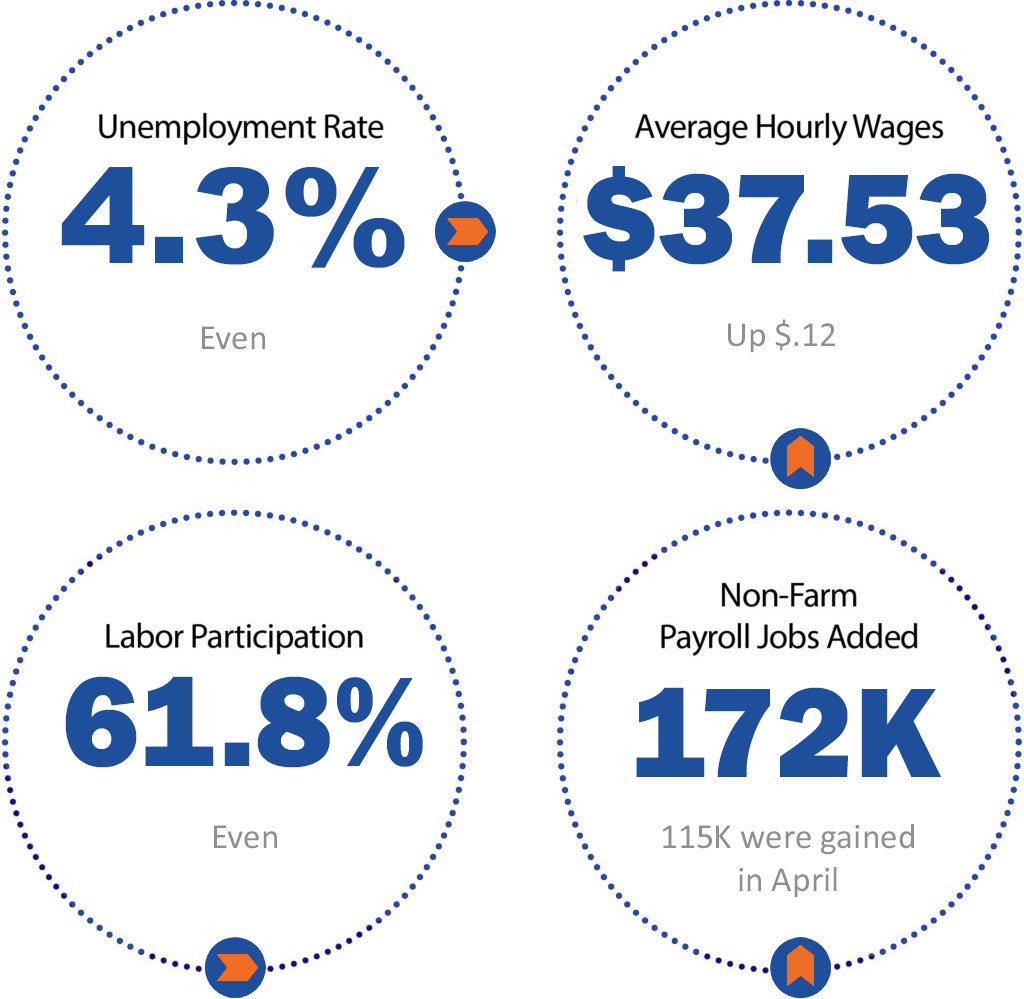
- Total nonfarm payroll employment edged up by 172,000 in May, and the unemployment rate was unchanged at 4.3 percent.
- Job gains occurred in leisure and hospitality, local government, and health care. Employment in financial activities declined.
- The number of long-term unemployed (those jobless for 27 weeks or more) was little changed over the month at 2.0 million but is up by 524,000 over the year.
- The number of people employed part time for economic reasons, at 4.8 million, changed little in May.
Looking Forward:
- “Friday’s jobs report was much stronger-than-expected and
shows that the labor market is turning a corner after a rough
past 12 months driven by fears of AI and uncertainty over
geopolitics and tariffs,” Glen Smith, chief investment officer at
GDS Wealth Management, said in an email. “The revival of the labor
market makes the Federal Reserve’s job easier and allows it to keep
rates steady in the meantime as it assesses the volatile inflation situation.”
- Economists had forecast an increase of around 80,000, following April’s initial estimate of a
115,000 gain that was revised upward to 179,000. The unemployment rate stayed the
same at 4.3%. Large gains came in the leisure and hospitality sector, where 70,000 jobs
were added, and in healthcare and social assistance, with 47,000 additional jobs.
Government hiring increased by 52,000.
- Overall, the reports paint a picture of a labor market that has stabilized following a slow start to the year. “There’s more confidence from employers, there’s relative stability with the tariffs, inflation and interest rates,” says ZipRecruiter economist Nicole Bachaud. “We’re still seeing growth,” says Sarah Breiner, an area vice president at staffing firm Adecco. She added that “wages are stabilizing as a whole.”
- And a new study by the Federal Reserve Bank of New York identified a different culprit for young people’s struggle to land jobs after college: the rise of remote work. Businesses, it seems, are reluctant to hire new grads for work-at-home jobs because it is harder to train and mentor them when they aren’t coming into the office.
Source: U.S. Bureau of Labor Statistics – The Employment Situation – May 2026
